Building Beautiful Futures Part 1: Taboos Around Discussing Money & Giving
Let’s talk about money. There are taboos in our society against talking openly about money, philanthropy, and the way we use our resources.
I have a generous aunt and uncle who never had much money in their younger years. Later in life, they come into more wealth. As they began to give to causes they cared about, they realized that most families don’t discuss philanthropy. So they started a experimental family-centered charitable trust, giving members of their extended family control over small portions of annual donations. It was mandatory that family members had conversations about annual distributions, either on the phone or in person. Emails would not suffice—we needed to give our reasons, talk about values and the future we wanted to contribute to.
So I found myself having long conversations every year about where I wanted to donate a hundred dollars. The conversations were all about my dreams and values. We talked about the good I wanted to see in the world and the future I hoped to live in. My small donations maybe didn’t warrant hours of deliberation, but the impact it had on me was profound. Those conversations fed my imagination. They are part of why I started this nonprofit.
Over the years, the family members who were the most engaged with the giving process were typically the ones who had the smallest salaries. This is related to frightening trends found by researchers: the wealthier somebody is, the less generous they tend to be. Of course, in terms of aggregate giving, the wealthy do give the most total dollars, but they give a smaller percentage of their income. According to a study done by Independent Sector (a network of nonprofits), people earning under $30,000 per year donate 4.2% of their income, while higher income brackets average just 2.7%. We need to be talking about this.
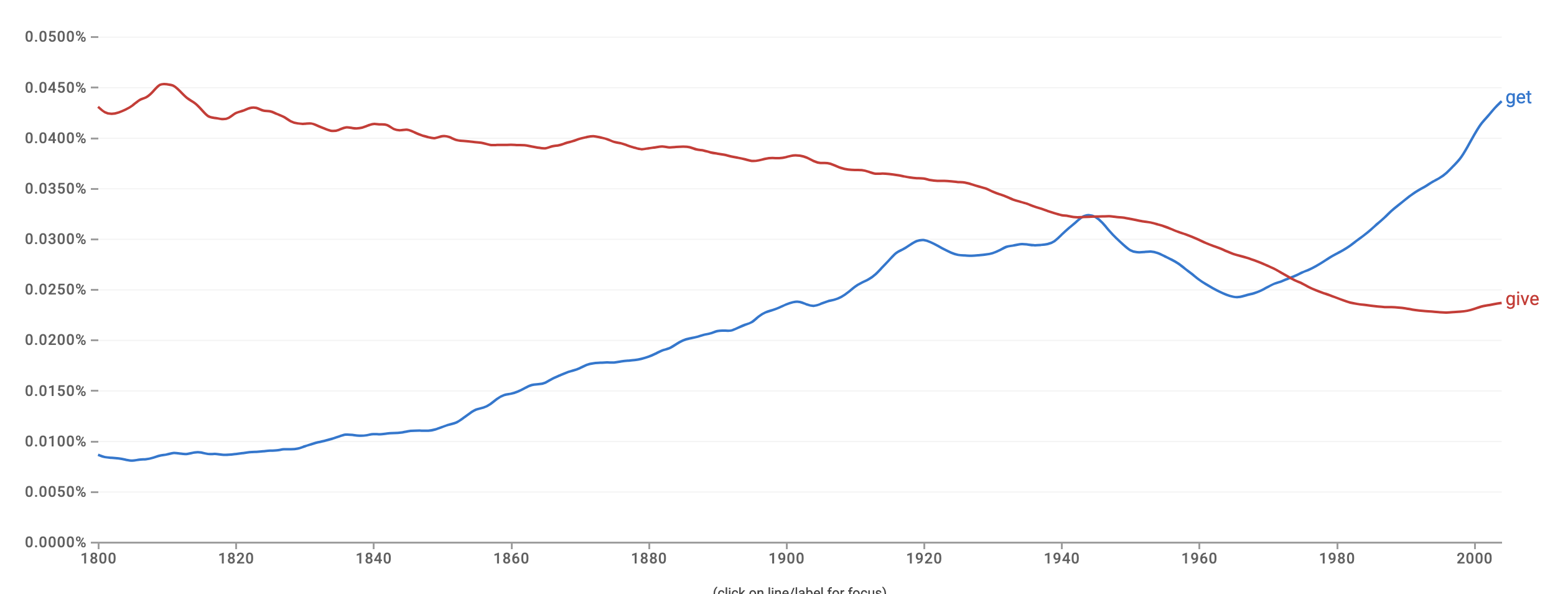
A quick search of Google’s Ngram, a website showing how often words are used in books published each year, shows that in our published language, the word “get” has nearly doubled in use at the same time that “give” has seen a steady decline. While many things could explain the rise of “get” over “give” in books, but I’m left with a feeling that this chart describes our society at its core. As we talk and write more about getting than about giving, it impacts the way we behave in the world.
This fall, I was leading a group of 18-20 year olds on the final portion of an outdoor semester. They had been living minimally for 3 months—everything they needed was in their backpacks. I asked them if they felt any material lack throughout their semester, and they all answered that the close relationships they experienced made them forget that they just had a single set of clothes. Naturally, our conversations often centered on consumerism and what it means to lead a good life. These young people wanted to create lives for themselves that were less materialistic, slower-paced, community-centered, and focused on creating a better world for everybody. As they talked about things like consumerism, material wealth, and generosity, the world felt different: they began to imagine their futures more vividly and to have a faith in the future that is hard to find in young people.
One evening on the trip, we read one of my favorite articles: “The Gospel of Consumption”. The author writes, “By 1991 the amount of goods and services produced for each hour of labor was double what it had been in 1948. By 2006 that figure had risen another 30 percent. In other words, if as a society we made a collective decision to get by on the amount we produced and consumed seventeen years ago, we could cut back from the standard forty-hour week to 5.3 hours per day — or 2.7 hours if we were willing to return to the 1948 level.” Talking about consumerism like this gives us perspective on the systems we take for granted.
We simply need to be talking about money more. We are living in the wealthiest nation in the world, yet the sense of scarcity in our society is extreme. Scarcity begins with our thoughts and words. When we can start talking about generosity, we shift the conversation towards a world where we trust that if we give, we are creating a better world for everybody, including ourselves.
On another night that trip, we read from “The Serviceberry” by Robin Wall Kimmerer. She writes, “In a gift economy, wealth is understood as having enough to share, and the practice for dealing with abundance is to give it away.”
Our world is in desperate need of people who can dream big about the future they want to live in, the future they want their children to inherit. Mainstream culture is not promoting that view—young people are being fed a diet of cold, hard consumerism. The way to fight back is by elevating giving to something that’s discussed openly.
So, this December, as nonprofits are asking for your donations, I challenge you to:
- Normalize talking about generosity and giving. Talk to your friends and family which causes they care the most about, and which organizations they give to on a regular basis.
- Frame giving as becoming a part of an organization. Nonprofits are collective efforts, and they rely on your faith and trust. Our donors are a part of us.
- Challenge your own assumptions about giving and ask yourself whether you are giving enough to the world, whether in material resources, time, or other ways.
- Talk about values. What values do you want your world to embody, and which organizations are helping that happen?
- Talk about strategy and consistency. How often do you give? Can organizations depend on you in the long-run? My next essay will talk more about consistency in funding.
- Donate to or volunteer with at least one organization you admire. While we would love your support, we won’t be offended if you don’t choose us—there are a lot of organizations doing good out there.