Groundwork believes that strong relationships with the Earth are a right, not a privilege. We use experimental financial models as part of our commitment to equity and access in environmental education.
Our Commitment
Groundwork is committed to challenging colonialism, capitalism, and their legacies, including white supremacy and economic inequity. As part of this commitment, we strive to make our programs accessible to as many people as possible, experimenting with different financial models that aim to bring more equity to environmental education and to counter societal and historical trends that push environmental education out of reach for people who have been disadvantaged in society through no fault of their own. We believe that everybody deserves the opportunity to build relationships with our common home, and that deeper relationships with the Earth form a foundation not only for a sustainable and livable future, but for a joyful, just, and equitable future as well.
Groundwork’s Sliding Scale Tuition
- Tier 5: Sharing Abundance — 130%
- Tier 4: Give A Little Extra — 115%
- Tier 3: Actual Cost — 100%
- Tier 2: Small Discount — 90%
- Tier 1: Community Supported — 80%
In our society, you can easily stand in line at the grocery store between somebody who earns $250,000 per year and somebody earning 10 times less: $25,000. Talking about financial inequality is largely taboo. We want to make our programs accessible to both of these people without creating feelings of guilt. In 2025, we launched a new sliding scale model that:
- Had fewer tiers to make the scale seem more simple.
- Clearly communicates what Groundwork’s cost is for programs. This creates understanding and encourages people to pay in the center of the scale, making it a true sliding scale rather than a request to give extra if you can. We see 80% of participants paying at actual cost.
- Gives names to pricing tiers, encouraging the mindset we hope to engender with each. The tiers closest to actual cost carry nonchalant names (“Offer a little extra” and “Small discount”), while the outer ends have names with a little more weight.
- Goes higher that it goes lower. We believe that the rich in our world have so much that they can afford to pay more. Initially, this scale went to 140%, but we saw so few paying that tier that we lowered it to 130%. We’re still tweaking this.
Tier 5: Sharing Abundance
Choose this tier if:
- You experience financial abundance and ease.
- You comfortably meet all your basic needs and don’t question paying for additional wants.
- You have abundant access to wealth, savings, property, or family support
This tier is set at 130% of the program’s actual cost. Acknowledging that those who have more tend to have exponentially more, our sliding scale goes higher on this end of the sliding scale. By choosing this tier, you are providing the opportunity for two people to take the class at discounted rates.
Tier 4: Give A Little Extra
Choose this tier if:
- You experience financial ease.
- You comfortably meet all your basic needs and often spend on extras like drinks out, travel, and entertainment.
- You have some access to wealth, savings, property, or family support
For participants who have a little extra to offer, this tier helps sustain our sliding scale model and funds people who may not be able to afford a program otherwise. This tier is set at 115% of the actual cost for a program.
Tier 3: Actual Cost
Choose this tier if:
- You can meet your basic needs and occasionally afford extras like a meal out at a nice restaurant
- You have a budget for travel
- You are financially stable in the present moment
This tier represents the actual cost for a program, including pay for teachers, supplies, facility rental, advertising, insurance, and administrative costs.
Tier 2: Small Discount
Chose this tier if:
- You can reliably meet your basic needs
- You live a good life, but you need to watch your spending on non-essentials
- When making financial choices, you pay close attention and often choose the least expensive options
Would a 10% discount make a big difference for you? This is the tier for you!
Tier 1: Community Supported
Choose this tier if:
- You sometimes (or often) struggle to meet your basic needs
- You have little or no disposable income or savings
- This class would be out of reach for you without a discount.
We value you and want you to have the opportunity to attend our programs! Groundwork programs are designed to be rich spaces where beautiful futures feel more possible, and we want you to be a part of it. This community supported tuition level is set at 80% of actual cost and is funded by people choosing to pay at the higher end of the sliding scale. If this tier’s tuition is still out of your reach, please reach out and we can discuss further scholarship options.
Past Financial Models
Groundwork has experimented with 4 different financial models since 2021. Each model had its pros and cons. If you are working on a sliding scale for your organization or curious to talk about our experiences with these tuition models, please contact us! We love to share our experiences!
Jump to a financial model:
- The Slider Model
- The Bottle Model
- The Fellowship Model
- The Unlabeled Sliding Scale Model
- The Low-Cost Set Tuition Model
The Slider Model
Our Slider Model was used for the following programs: Human & Natural Ecologies of Colorado.
In this model, tuition is set on a sliding scale with 22 specific household income brackets paying percentages of a base tuition. On program pages using the Slider Model, the tuition slider starts on the base tuition ($60,000-$65,000 income bracket), and slides from 65% of tuition at the lowest end to 185% at the highest. For reference, the percentages were set in 2022.
The Slider Model clearly defines a sliding scale and aims to:
-
-
- Give guidance and clarity for how income relates to our sliding scale. Most tiered payment systems leave people uncertain which level they should pay at.
- Provide up-front transparency in our tuition and financial aid.
- Alleviate the undue hardships that scholarship systems place on people with fewer economic resources (more on this below).
-
As an example, the Slider Model below would be for a Groundwork program with a starting tuition of $100.
Household Income:
Program Tuition:
The Underlying Numbers
| Household Income | Percent of Tuition |
|---|---|
| Under $25,000 | 65% |
| $25,000–$30,000 | 68% |
| $30,000-$35,000 | 71% |
| $35,000-$40,000 | 76% |
| $40,000-$45,000 | 81% |
| $45,000-$50,000 | 86% |
| $50,000-$55,000 | 91% |
| $55,000-$60,000 | 96% |
| $60,000-$65,000 | 100% |
| $65,000-$70,000 | 106% |
| $70,000-$75,000 | 112% |
| $75,000-$80,000 | 118% |
| $80,000-$85,000 | 124% |
| $85,000-$90,000 | 130% |
| $90,000-$95,000 | 136% |
| $95,000-$100,000 | 142% |
| $100,000-$105,000 | 148% |
| $105,000-$115,000 | 154% |
| $115,000-$125,000 | 160% |
| $125,000-$135,000 | 166% |
| $135,000-$150,000 | 172% |
| Above $150,000 | 178% |
For households in the highest income bracket on our Slider Model, we did not continue to increase tuition. Instead, we asked that in addition to the tuition Groundwork, participants make proportional contributions to other organizations working on environmental justice, food sovereignty, and related issues.
The Bottle Model
Our Bottle Model was used for the following programs: Naturalist Homeschool Program (2023-24 school year).
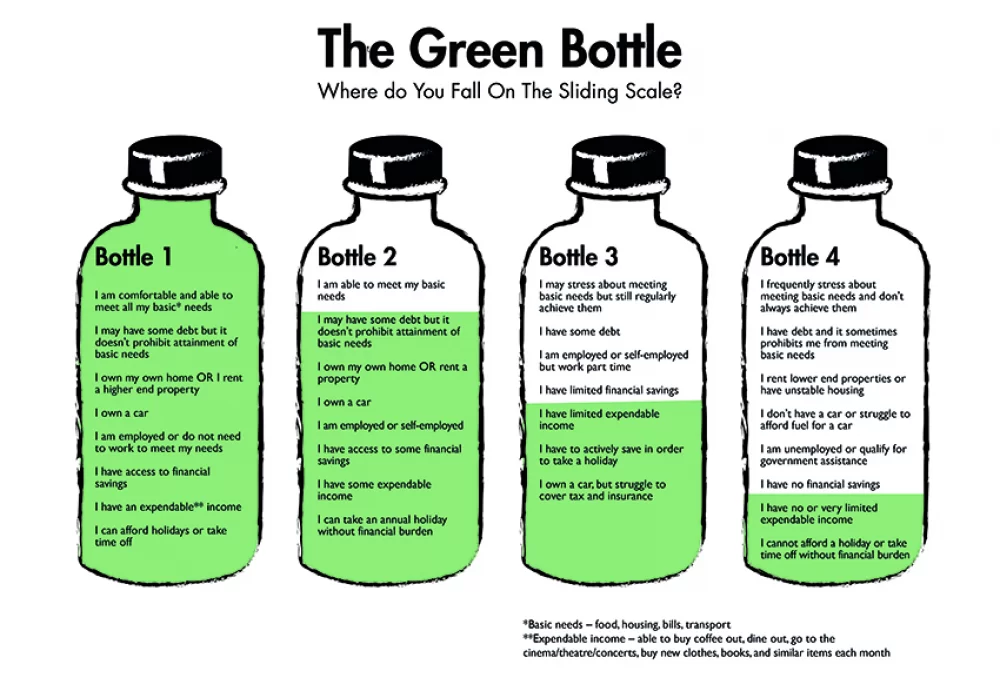
Tuition for the 2023-2024 Naturalist Homeschool Immersion is determined by families based on where they assess themselves to be within this bottle model. Your contribution covers the teacher’s salary, classroom and office materials, and skill-based materials. Tuition does not include student’s personal materials, transportation, or other trip/event associated costs.
The Fellowship Model
Our Fellowship Model is used for the following programs: Food Systems Fellowship and Lithium Lands Fellowship.
This model offers experiences as an exchange. Generally, participants receive food, rustic housing, and a small stipend in exchange for taking part in activities that help pay for the whole experience. On our farm in Colorado, fellows help with farm operations. On the Lithium Lands Fellowship, participants take part in scientific surveys.
Our Fellowship Model is designed to be the most radical of our tuition models. For this model to function well, fellows and mentors alike need to step outside of cultural norms and experiment with radical forms of communal relationships. On our fellowship programs, participants and mentors live and work together, forming small intentional communities based around engaging with the Earth in mutually beneficial ways. Education is no longer a product to be sold, but a product of daily life. Learning produces not only knowledge, but valuable products like vegetables that can feed participants and be sold to finance the whole program. We see this model as the most sustainable model for the future, taking successful elements from traditional structures like apprenticeships and village-style living. The Fellowship Model is empowering for people who lack privilege: it puts education back into the hands of everyday people and has the potential to free education from the need for large amounts of capital.
The Unlabeled Sliding Scale Model
Our Unlabeled Sliding Scale Model was used for the following programs: Groundwork Folk School (classes from 2023-2025).
When our folk school launched, we used a simple 10-tier sliding scale in $10 increments. For example, a basketry class might have a range from $150-250, offering increments at $150, $160, $170, etc. We found that participants signed up at all levels of the sliding scale, though commonly defaulted to the lowest number, especially in low-income or rural areas. As we began budgeting around the 80-90% of participants who would pay at the low end of the sliding scale, it evolved into less of a true sliding scale. Instead, it began to seem that we had a low tuition, with asks for donations above that. This model evolved into our current sliding scale with fewer tiers that carry informative labels. (See the top of this page for more on the updated version).
The Low-Cost Set Tuition Model: Naturalist Middle School Tuition
Our Low-Cost Set Tuition Model was used for the following programs: Naturalist Homeschool Program (2024-25 school year).
This For programs that are offered at below-market rates, setting a tuition allows for more precise budgeting and planning. We moved to this model for the 2024-2025 school year for the Naturalist Middle School. Tuition covers the teacher’s salary, classroom and office materials, and skill-based materials. Tuition does not include student’s personal materials, transportation, or other trip/event associated costs. For small programs, we have found that this model lets us plan the best.
Frequently Asked Questions
How do you define a household’s income for the Slider Model?
If nobody can claim you as a dependent on their U.S. federal income taxes, we define your household income as your average adjusted gross income over the past 2 years, plus all realized and unrealized capital gains from that time period.
If somebody can claim you as a dependent on their U.S. federal income taxes, we define your household income as whichever adjusted gross income plus capital gains are higher—yours or theirs. We know that our definition is based on U.S. tax systems—if you pay taxes in a country besides the United States, please contact us about your situation, and we’ll find a tuition that works for you.
What if I have a unique situation that should be accounted for separately?
If you think your case has additional considerations that might alter how we should place you on the payment scale, please contact us directly. A few examples of additional considerations are: you provide financial support to your family, your tax documents need additional context to accurately reflect your situation, or you have outstanding medical or legal bills.
Why not scholarships?
We see that scholarship systems disincentivize people with fewer economic means from pursuing education in four ways:
- Dependence on scholarships place undue uncertainty onto an application process.
- Scholarship-based systems create sticker shock while leaving the final price for any prospective student a mystery. This complicates decisions to apply.
- Scholarship-based systems devalue people with less economic power by asking them to prove themselves worthy. These people must work harder to apply.
- Scholarship-based systems can prejudice organizations against scholarship-seekers, because it requires greater administrative effort to process and review applications for scholarships.
How can I give feedback about your tuition structures?
We acknowledge that our systems are not perfect. The Slider Model does not encompass one of the biggest variables that defines economic power: net worth and generational wealth. All our models leave a lot of decisions in the hands of people applying for programs, and there is potential for deception when self-selecting which level to pay at. If you think that a tuition model does not accurately reflect your financial situation, feel free to contact us and we can talk about your situation. If you have suggestions for ways to improve this system, please let us know!
My organization is considering a similar structure to one of your models. Do you have any advice?
Please get ahold of us—we would love to chat with you about your perspectives on equitable pay structures! Our structures are experimental, and we would love to share the lessons we have learned.
Inspiration and Thanks
We owe our thanks to generative somatics, The Wild Garden, Green Door Folk School, Global Focus Coaching, and A Bookkeeping Cooperative for influencing our thinking about sliding scale structures.
The Fellowship Model was heavily influenced by Mission: Wolf in Westcliffe, Colorado, Pun Pun Farm in Mae Taeng, Thailand, and SECMOL in Ladakh, India.